

Does Milk Makeup Have Mica In It
Hither's What'due south *Really* Behind the Shimmer in Your Fave Makeup
In many cases... child labour
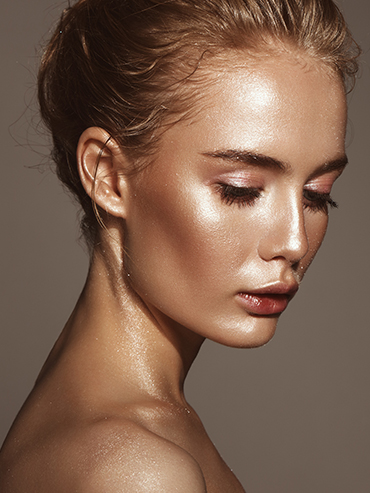

If yous're obsessed with makeup, your beauty routine probably consists of a poppin' highlight, glossy lips and glitter cut creases—only have yous ever wondered where all that shine actually comes from?
Chances are, the ingredient that makes your nail polish cogitating and your highlight glisten is mica, which is the proper name for a group of 37 naturally occurring minerals that are used in diverse industries, including cosmetics, automotive, tech and structure. Mica adds shine to cosmetics and auto paint, but it's also used every bit an electrical conductor in electronics, a more durable alternative to glass in stoves and kerosene heaters, and fifty-fifty as a soil conditioner in potting soil mixes. All of which is to say, mica is a valuable substance. In fact, the Centre for Research on Multinational Corporations (SOMO) predicts the market for this grouping of minerals will grow to well-nigh $700 million USDin 2024.
Mica can be found in People's republic of china, Russia, Finland, the U.S. and even here in Canada, but the cosmetics industry overwhelmingly sources its supply from India, where it's often mined by children as young as four or five years old. (Horrifyingly, this is because their easily are pocket-size enough to fit into the tight crevices where mica is usually plant.)
The problems with mica mining take merely received mainstream attending in the past few years, and fifty-fifty and then, by and large in Europe—British Vogue,Wired, The Guardianand Spiegel take all reported on the link betwixt shimmery makeup and child labour. But despite growing media attention on this side of the pond, Canadian consumers likely aren't always aware of the issue. In fact, co-ordinate to a 2018 written report published by World Vision, nosotros're spending more than than e'er on products that are likely to include child labour in their supply bondage—$798.2 1000000, to exist exact, which is upwardly 136% over the past 10 years.
Though "cruelty-free makeup" has long been about brute testing, these numbers make it articulate: information technology's high time the term starts to cover child labour, besides.
Mica mining is "dirty, dangerous and degrading"
According to SOMO , a quarter of the earth's mica comes from the eastern Indian states of Jharkand and Bihar, where more 22,000 children work in mica mines. Mines in these states are often illegal and unregulated—it's mutual to see children crouching on dusty floors, sifting through crumbling powder for hours on cease, looking for trivial clusters of mica. Some of these kids were kidnapped and forced into child labour. Simply in many cases, they're working aslope their parents, who accept pulled them out of school to help support the family.
"[Poverty] forces people from disadvantaged communities to take up these risky jobs and rely on children to assistance provide for their families instead of sending them to school," says Jakub Sobik, the communications manager at Anti-Slavery International.
And these jobs are very risky. According to 2016 investigation past Reuters, 7 children died in mica mines in just two months. Since using children to mine mica is illegal, the people running these mines are operating under the radar, and there are very few safety regulations, like reinforced walls or protective equipment. Mine collapses are quite common, children utilize hazardous equipment, similar picks and hammers and, according to a recent commodity in Marie Claire, they're constantly breathing in "fine particles [of mica, which] can lead to respiratory conditions like asthma, silicosis, and tuberculosis."
"That kind of poverty is not very familiar to Canadians," says Cheryl Hotchkiss, the vice president of public engagement at Globe Vision Canada. "These are families that really have no other choice."
But in that location is solution to this trouble. Or rather, there are three: Families need a style out of poverty, brands demand to accept a closer expect at their supply chains and consumers need to take action, likewise.
Beauty brands demand to be more transparent about their supply chains
In that location are charities that are working to stop child labour in the mica mining industry, including Anti-Slavery International, Terre des Hommes, Kailash Satyarthi Children's Foundation, Thomas Reuters Foundation and World Vision Canada. And they're not the only ones agitating for change; according to the Shareholder Association for Enquiry & Instruction (SHARE), business leaders want the Canadian government to take action in the form of supply chain transparency legislation, which would require companies to disclose where their mica comes from.
This is key, because cosmetic companies have been slow to detect "clean" sources of the mineral. Just 18% of a pool of sixty Canadian companies with mica-containing products provided detailed show of their delivery to prevent kid labour in their supply chains, according to the World Vision report.
Procter & Hazard, Coty Inc. and L'Oréal Paris Group are three of the largest brands that use mica. Fifty'Oréal Paris Grouping, which owns brands like 50'Oréal and Maybelline and sells 948 mica-containing products, is 1 of the few cosmetic brands that directly addresses its mica supply chain on its website, saying it sources "from legal gated mines only, where working conditions can be closely monitored and human rights respected." The company says most of its mica comes from America, and that as of 2017, its Indian supply concatenation is mostly secured.
And Coty, which owns CoverGirl, OPI, Emerge Hansen and Rimmel London, has at least acknowledged that its supply concatenation may include child labour. In a June 2017 report, the company says it, "has joined the Responsible Mica Initiative along with our suppliers and competitors to collaboratively address these complex problems and aims to accomplish a responsible mica supply chain over the next five years."
In contrast, Procter & Gamble says very little most its mica supply chain—though a 2016Guardian investigation linked the cosmetics giant to Indian mines that use child labour.
(FLARE reached out to Procter & Gamble, Coty Inc., Maybelline and Fifty'Oreal Paris Grouping for annotate, but didn't receive a response by press time.)
"Companies at the very least should have a better insight into what's in their supply chains," Hotchkiss says. "Many people don't know that inside their supply chain at that place may be a child that is doing work that is muddy, unsafe and degrading. If they knew, they would practise something about information technology."
But consumers need to to demand answers, also.
Advancement is cardinal, and so what can Canadian consumers practice?
If y'all're a Canadian makeup lover, taking activity is really quite simple.
"Accomplish out to your favourite make… and ask them what they know about their mica supply chain," says Candace Grenier, the founder of Pure Anada. The sustainable cosmetics visitor is dedicated to using ethically-sourced mica without the use of kid labour in their products. Agree brands accountable by reaching out to the human resources department, spreading awareness on social media or investing your money in beauty products that are sustainable, eco-friendly and cruelty-costless (for animals and people).
Grenier hadn't considered asking about her mica supply chain when she started in 2014—until she got an email from ecology journalist Adria Vasil asking her where her pigment came from.
"I was worried it would exist the stop of my company," she says. So, she made a change. She constitute a mica supplier that is transparent about its practices and is dedicated to ethical mica mining. According to Pure Anada's website, the supplier owns the mines and funds daycare and school programs to help improve the quality of life for its employees in India.
The biggest challenge with sourcing sustainable mica is product consistency, according to Grenier. Because they're dealing with natural ingredients that are harvested or mined, information technology tin alter from flavor to season, so the texture, color and aroma might be different each fourth dimension you buy the production, unlike big companies who mass produce their products to ensure consistency.
"Pure Anada is different," she says. "It's non going to be the verbal aforementioned equally a make you'd find in a drug store or a department shop, but the things that make us dissimilar are the things that I'm proud of."
Grenier says the majority of customers are actually understanding of this product inconsistency because it'south important that brands are transparent.
"I am purchasing raw materials and supplies that are helping to support other people, even if information technology means it costs more," she says. "Merely I wouldn't want to do information technology whatsoever other way."
're Loving RN
Source: https://fashionmagazine.com/flare/mica-makeup-child-labour/
Posted by: chasteennord1954.blogspot.com
0 Response to "Does Milk Makeup Have Mica In It"
Post a Comment